The Battle of Pozières
July 23, 2026
This year marks the 110th anniversary of the Battle of Pozières, a battle remembered with deep respect for the sacrifice and perseverance of those who served there.
Near the French village of Pozières, the Australian Imperial Force endured some of the heaviest losses of the First World War. In only a few weeks, Australian casualties at Pozières approached the scale of those suffered over eight months at Gallipoli.
The village was first captured by the 1st Division on 23 July 1916. The men held their ground under almost continuous artillery fire and repeated German counter-attacks, but the cost was immense. When the division was relieved on 27 July, it had suffered 5,285 casualties.
The 2nd Division then took over the line. Its first attack, on 29 July, ended in costly failure. A second attack, on 2 August, secured further German positions beyond the village, but once again the Australians endured heavy retaliatory bombardment. By the time they were relieved on 6 August, the division had suffered 6,848 casualties.
The 4th Division was next sent into the line at Pozières. It too faced intense artillery fire and, on 7 August, helped defeat the final German attempt to retake the village.
Pozières holds an important place in Australia’s military history. It also has a lasting connection to the history and purpose of Legacy. Many of Legacy’s founding Legatees from the 24th Battalion, served at Pozières and carried the memory of that battlefield into their later work of care and service.
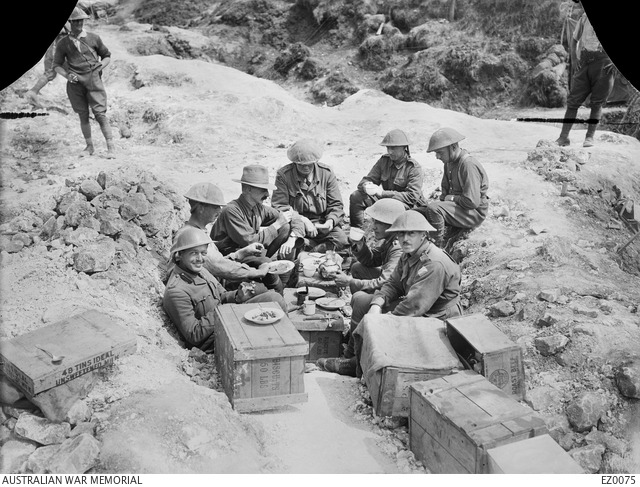
Pozières, France. 1916. Third from the left is General John Gellibrand CB DSO DSM from East Risdon, Tasmania (founder of the Legacy movement). Sitting on the rim of the shell hole is Captain Stanley George Savige MC, DSO, 24th Battalion From Prahran, Victoria (Founder of Melbourne Legacy).
Image courtesy of the Australian War Memorial.
Legatee Kem Kemsley was one of Legacy’s founding Legatees. He served Legacy for more than 60 years and was a Trustee at the Shrine of Remembrance for 54 years.
In later years, he reflected on his experience at Pozières and the way it shaped his lifelong commitment to Legacy.
The first time I came under gunfire of the enemy was Pozières in France on the 20th July 1916.
On that lovely sunshining morning, we went up towards the line and for the first time in my life I had seen some dead colleagues waiting to be buried. I can’t describe to you the emotion and what it did to me, but from that day onwards, the war had an entirely different meaning.
Till then war had been an adventure as far as I was concerned and I loved the Army and enjoyed it, but from that morning on I had an entirely different attitude because as I saw these fellows, one man still had his bayonet and his rifle in his hands, waiting beside the road, this upset me terribly.
I’ll never forget that image, and I got this spirit at that time, never knowing that it was going to apply to me so much in my Legacy years, but I put my interest in Legacy and the dedication I have given to it, goes back to that day.”
Legatee Kem Kemsley
The courage, sacrifice and mateship shown by Australian troops at Pozières, and in the battles that followed, remain part of Legacy’s story today.
After the war, Captain Stanley Savige and other First World War veterans recognised the profound need to care for the families of those who had not returned. In honouring their fallen comrades, they made a promise to stand beside widows and guide and support children left without a parent.
That promise lives on in Legacy’s enduring commitment to look after the “missus and the kids”, and ensure that the families of veterans are never left to face life’s challenges alone.
Share page